IWB vs OWB Carry: Which Is Better for Concealed Carry? (2026)
Quick answer: IWB (inside the waistband) carry hides a handgun better and is the most common choice for everyday concealed carry. OWB (outside the waistband) carry is usually more comfortable and faster to reach, but needs a longer cover garment such as an untucked shirt or jacket to stay concealed. Most people who carry concealed daily choose IWB; OWB suits colder months, larger frames, open-carry areas and range use.
Reviewed and updated October 31, 2026 by Daniel Guerra. Rewritten as a neutral comparison; no new hands-on testing was done for this update.
| Factor | IWB vs OWB |
|---|---|
| Concealment | IWB is easier to hide under a T-shirt vs OWB needs a longer or looser cover garment |
| Comfort | IWB presses into the body and needs pants with room vs OWB rides outside the pants |
| Draw | IWB requires clearing the shirt and a deeper grip vs OWB is usually faster and easier |
| Gun size | IWB favors micro and compact pistols vs OWB handles larger guns more comfortably |
| Belt | Both need a stiff gun belt |
| Best for | IWB: daily concealed carry in light clothing. OWB: cool weather, jackets, open carry, range and duty-style use |
Next steps: compare IWB holsters, OWB holsters and gun belts, or see every option in our concealed carry positions guide.
What Is IWB Carry?
IWB stands for inside the waistband. The holster sits between your body and your pants and attaches to the belt with clips or loops, so only the grip rides above the beltline. A loose T-shirt or untucked button-down can cover it.
IWB positions are described like a clock face, with 12 o’clock at the belt buckle. For a right-handed shooter, 3 o’clock is the hip and 4 to 5 o’clock is just behind it. Carrying in front of the hip, around 1 to 2 o’clock, is called appendix carry (AIWB), covered in our appendix carry guide.
Pros And Cons Of IWB Carry

- Best concealment. With the gun tucked inside the pants, a single cover layer is often enough, even in summer clothing.
- Better retention. A gun held against the body is harder for someone else to see or grab.
- Works with ordinary clothes. Many IWB holsters are tuckable, so a shirt can be tucked over the holster with only the clips showing.
- Comfort takes work. The holster takes up room in the waistband, so many people go up one pant size and need a few weeks to adjust.
- Slower draw. You have to clear the cover garment and get a full grip on a gun that sits lower and closer to the body.
What To Look For In An IWB Holster
- Full trigger-guard coverage from a rigid shell (Kydex or Boltaron) molded for your exact pistol, including any optic or light.
- Adjustable retention so the gun stays put when you bend or sit, yet draws cleanly.
- Adjustable ride height and cant to tune comfort and concealment for your body.
- A claw or wedge (especially for appendix) that pushes the grip toward your body to reduce printing.
- Clips that fit your belt width and grip it firmly.
Hybrid holsters, which pair a rigid front with a leather or foam backer, spread weight over a larger area and suit some people better. All-Kydex holsters are thinner and easier to re-holster with one hand. Either way, a stiff gun belt matters as much as the holster.
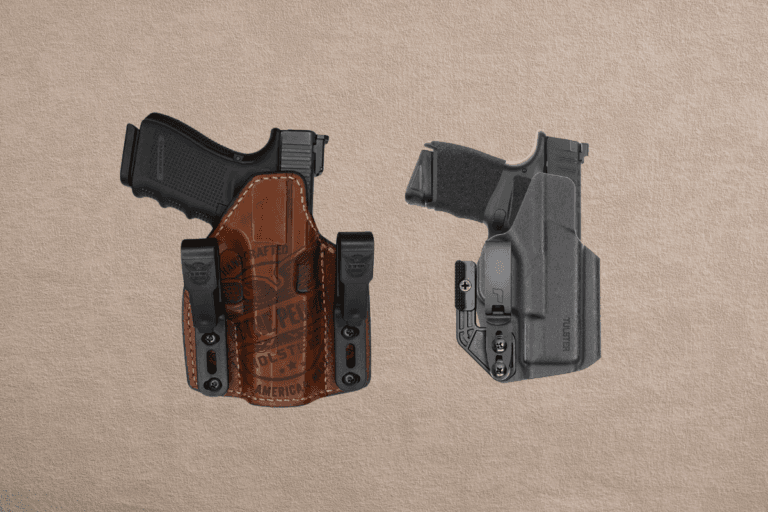
Two widely available model-specific IWB options are shown below. Tulster offers CCS readers 15% off with code CCS15 (checked in cart October 27, 2026).

- Gun model engraved in kydex
- Undercut Trigger Guard
- Adjustable Retention
- Top grade materials
Save 15% Code: CCS15

What Is OWB Carry?
OWB stands for outside the waistband: the holster mounts on the outside of the belt, the traditional hip-holster position. OWB does not have to mean open carry. With a holster that rides high and close to the body and a cover garment long enough to reach below it, OWB can be concealed.
Pros And Cons Of OWB Carry

- More comfortable. Nothing sits inside the pants, so your normal pant size works and long days at a desk or in a car are easier.
- Faster, easier draw. The grip sits higher and farther from the body, so a full grip is easier to get.
- Handles bigger guns. Compact and full-size pistols are easier to carry OWB than IWB.
- Harder to conceal. It needs a longer or heavier cover garment: an untucked overshirt, a jacket or a vest. It is easiest in cooler months.
- Exposed when you bend or reach. A short shirt can ride up and reveal the holster.
What To Look For In An OWB Holster
Start by deciding whether the gun will be concealed or carried openly.
- For open carry, prioritize retention. Duty-style holsters with active retention devices, such as Safariland’s retention holsters, add a hood or lock that must be released before drawing. Practice that release until it is automatic.
- For concealed OWB, look for a holster that rides high and tight against the body, with belt loops or slots spaced apart to pull the gun in close and reduce printing.
- In both cases, use a rigid holster made for your exact pistol that fully covers the trigger guard, on a belt stiff enough to hold the weight without sagging.
Tulster’s Contour is an OWB holster built to ride close to the body; WTP also makes OWB versions of many models. For more options, see our best OWB holsters and how to conceal carry OWB.

- Gun make & model engraved in Kydex.
- Designed for discreet and concealable carry.
- Optic-compatible to accommodate red dots.
- Adjustable ride height and retention for a personalized fit.
Save 15% Code CCS15
Is IWB Or OWB Carry Better?
It depends on what you value most and what you wear:
- Choose IWB if you want the gun hidden under a T-shirt or light clothing every day, carry a micro-compact or compact pistol, and are willing to spend a few weeks adjusting.
- Choose OWB if comfort is the priority, you carry a larger pistol, you regularly wear a jacket or overshirt, or you open carry where it is legal.
- Consider both. Many carriers use IWB for daily wear and OWB for cold months, range days or casual weekends. Practice your draw from each before you rely on it.
Whichever you choose, check the carry laws for your state and anywhere you travel. Our reciprocity guide covers permit recognition, and open-carry rules vary by state.
Related reading: Small of Back Carry: Why You Should Avoid It · How To Conceal Carry OWB: Holsters, Clothing & Position
IWB vs OWB FAQ
What does IWB mean?
IWB means inside the waistband: the holster sits between your body and your pants, clipped or looped to the belt, so only the grip rides above the beltline.
What does OWB mean?
OWB means outside the waistband: the holster mounts on the outside of the belt, like a traditional hip holster.
Is IWB or OWB more comfortable?
OWB is usually more comfortable because nothing sits inside the pants. IWB comfort depends heavily on holster design, a good belt and sizing your pants up if needed.
Can you conceal carry OWB?
Yes, with a holster that rides high and tight to the body, a sturdy belt and a cover garment that reaches past the bottom of the holster.
Which is better for beginners, IWB or OWB?
For daily concealed carry, most beginners start with a quality IWB holster worn at 3 or 4 o’clock or appendix. OWB is a comfortable way to practice at the range.
Conclusion
IWB is the default for everyday concealment; OWB trades some concealment for comfort and a faster draw. Your body type, clothing and pistol size decide which works better, and many people end up owning one of each. Pair either holster with a stiff concealed carry gun belt, and see our best concealed carry holsters to compare specific models.