

The 4 Rules of Gun Safety: Handling and Storage
The four rules of gun safety address four hazards: an assumed-unloaded firearm, an unsafe muzzle direction, unintended trigger contact, and an unidentified target or unsafe background. Apply them together whenever a firearm is handled. They reduce risk; they do not replace secure storage, the manufacturer’s instructions, or qualified instruction.
The Four Important Rules Of Gun Safety
- Loaded: Handle every firearm with the precautions you would use for a loaded one.
- Muzzle: Keep the barrel’s opening directed away from people and anything that must not be struck.
- Trigger: Keep your finger outside the trigger guard until you intend to fire.
- Target: Identify the target and assess the area around and beyond it. If uncertain, do not fire.
Organizations may use different wording or order. The underlying precautions work together: following one rule is never permission to ignore another.

Rule 1: Treat Every Firearm as if It’s Loaded
Do not rely on memory, another person’s assurance, or the appearance of a firearm to establish that it is unloaded. Removing a detachable magazine alone does not establish that the chamber is empty. Continue muzzle and trigger precautions even after its condition has been checked.
If you do not know how to establish the condition of that particular firearm safely, do not experiment with its controls. Get help from a qualified instructor and follow its owner’s manual.
FREE CARRY-GEAR CHECKLIST
Buy the right carry gear the first time.
A practical checklist to help you compare holsters, belts, and gear before you buy.
- Check exact-model compatibility
- Match your belt and holster
- Skip unnecessary add-ons
Rule 2: Always Point the Muzzle in a Safe Direction
A direction is not safe simply because nobody is immediately visible there. Consider people in adjoining rooms or on another floor, penetration through building materials, and ricochets. A floor, ceiling, wall, or patch of ground is not automatically a safe direction. The surroundings determine the risk.
At an established range, follow its designated firing direction, backstop requirements, and staff instructions. If the surroundings are uncertain, stop rather than guessing. This also applies during cleaning and unloaded handling.
Rule 3: Keep Your Finger Off the Trigger Until Ready to Shoot
During handling, keep the trigger finger outside the guard and away from the trigger. A decision to handle or move a firearm is not a decision to fire it. A mechanical safety does not replace this precaution.
Rule 4: Be Sure of Your Target and What’s Beyond It
Never fire at an unexplained sound, movement, shadow, or partly identified shape. Consider people and objects between you and the target, beside it, and beyond it. Projectiles can miss, pass through, or ricochet. An unidentified background is a reason not to fire.
New Zealand’s official safety guidance similarly emphasizes target identification and reassessing the surrounding area. It is cited here for those safety principles, not as a statement of U.S. law.
Secure Storage Is a Separate Safety Requirement
Safe handling rules do not prevent unauthorized access to a firearm left unsecured. When not in use, store firearms unloaded and locked, with ammunition secured separately. Keep storage keys and codes inaccessible to children and unauthorized people. Hiding a firearm, placing it on a high shelf, or telling children not to touch it is not a substitute for secure storage.
CDC recommends secure storage and links to Project ChildSafe guidance. The American Academy of Pediatrics advises that a home without firearms is safest for children; where firearms are present, it recommends locked, unloaded storage with ammunition locked separately.
If you’re comparing lockable options for a nightstand, see our bedside gun safe comparison.
Children, Visitors, and Unfamiliar Firearms
Teach children to stay away from a firearm, never touch or play with it, and tell a responsible adult immediately. Adults remain responsible for preventing access. Ask about firearm storage in homes children visit, including relatives’ and friends’ homes.
If you encounter an unfamiliar or unattended firearm, do not pick it up to investigate. Keep children and others away and seek appropriate help. If there is immediate danger, contact emergency services.
Additional Gun Safety Rules

- Use the manual: Safety devices and procedures differ among firearms. Do not improvise repairs or alter safety mechanisms.
- Avoid impairment: Alcohol, drugs, and some medicines can affect judgment or coordination. Do not handle firearms while impaired; ask a clinician or pharmacist about medication effects.
- Protect hearing and eyes: Use appropriate protection at the range and follow posted safety instructions.
- Follow manufacturer restrictions: Use only ammunition specified for the firearm. If something seems damaged, obstructed, or abnormal, stop using it and seek qualified assistance.
For supervised learning, choose qualified instruction that covers safe handling, storage, and the specific firearm’s manual. Reading an article is not a demonstration of competence.
Read 7 Common Concealed Carry Mistakes Many People Make
Gun Safety Questions
Is an empty magazine well proof that a firearm is unloaded?
No. A chambered round can remain. Do not relax the other safety precautions or guess at unfamiliar controls.
Is pointing toward the floor always safe?
No. Floors and walls may be penetrated, and hard surfaces can cause ricochets. Account for the actual surroundings and people beyond the visible surface.
Does the safety switch make careless handling safe?
No. A mechanical device supplements safe handling; it does not replace muzzle control or keeping fingers away from the trigger.
Is teaching children the rules enough?
No. Child-safety education does not replace adult-controlled, locked storage. Children and teens must not be able to access keys or combinations.
Related reading: How To Prepare for Your Concealed Carry Permit Class · How To Clean Your Concealed Carry Gun: 7 Steps
Conclusion
Use all four precautions consistently, secure firearms against unauthorized access, and stop whenever a condition or instruction is unclear. No equipment purchase removes these responsibilities.
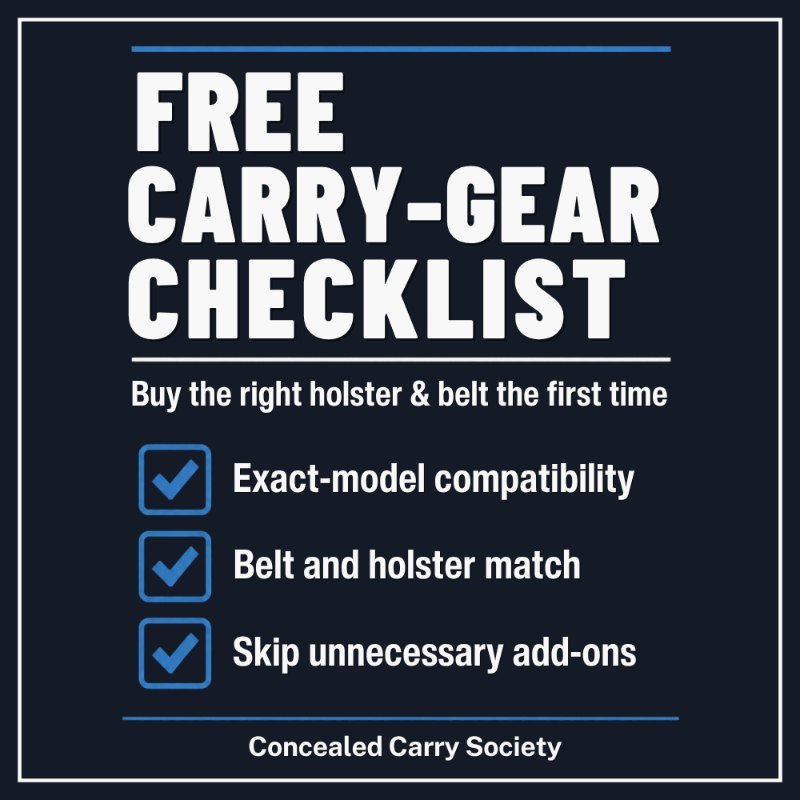
Buying a holster or belt? Get our free carry-gear checklist by email and order gear that fits your exact setup the first time.
Free. Unsubscribe anytime.
Sources and Editorial Review
Reviewed October 24, 2026 against the sources below. Use the owner’s manual and qualified instruction for firearm-specific procedures. These sources provide safety principles; this article does not establish local legal requirements.


