
Vehicle Firearm Storage & Transport Guide (2026)
A firearm in a vehicle creates a storage responsibility. A locked door, hidden bag or ordinary console does not establish protection against theft or unauthorized access. If temporary vehicle storage is unavoidable, the priority is a suitable locking device and a plan to return the firearm to secure home storage.
This guide explains storage options, the questions to ask before buying a lockbox, basic interstate-transport conditions and what to do after a theft. Updated October 25, 2026.
Temporary storage · Lockbox checklist · Transport rules · Theft response · FAQs
Temporary Vehicle Storage: The Essentials
Project ChildSafe advises using locked temporary storage, keeping it out of sight and securing the device to the vehicle where possible. Keep firearms inaccessible to children and pets. Minimize unattended time; on arriving home, move the firearm to secure home storage.
Follow the firearm manufacturer’s safe-handling instructions. ATF’s vehicle guidance calls for checking that firearms are unloaded before storage. Do not handle a firearm while driving or attempt unfamiliar unloading procedures in a confined space.
Reference: Project ChildSafe: firearm storage in vehicles and ATF: safe storage and theft response.
A Portable Lockbox to Consider
SnapSafe TrekLite XL Combination Lockbox — model 75241
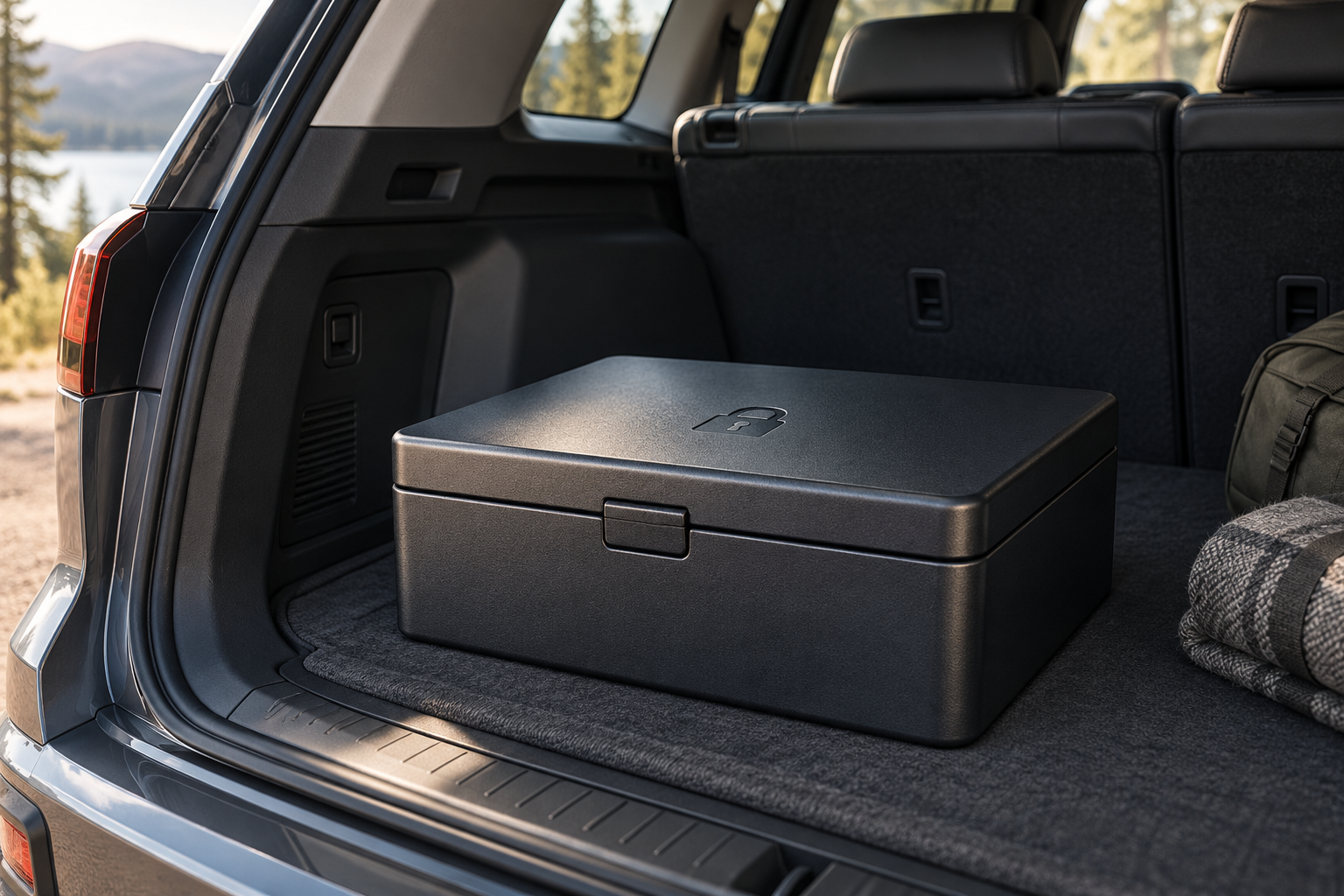
SnapSafe lists a polycarbonate shell, four-digit combination lock, foam lining and included security cable. External dimensions are 10 × 7 × 2 inches; usable interior space must be checked separately.
Pros: Combination entry avoids carrying a separate key; portable construction suits temporary storage.
Tradeoffs: This is a portable polycarbonate box, not a steel vehicle vault. We have not tested break-in or crash resistance. SnapSafe’s FAQ says TrekLite boxes are not California DOJ approved. A cable strength claim is not a security rating for the entire box.
Before ordering: Confirm model 75241, usable interior dimensions, attachment requirements and applicable storage rules.
Check lockbox price and availability at PSA
Affiliate disclosure: We may earn a commission from purchases through this link, at no additional cost to you.
Specifications checked October 25, 2026 against SnapSafe’s product page and FAQ. Retail price, availability and delivery can change.
Storage Options Serve Different Purposes
| Storage type | Purpose and limits |
|---|---|
| Padded transport bag | Protects against ordinary transport damage. A zipper or soft shell does not establish theft resistance. |
| Portable locking case | Assess the lock, construction and manufacturer-approved attachment. Portability also means the whole case may be removable. |
| Vehicle-specific console safe | Check the exact vehicle and model-year fit. An aftermarket safe is different from the factory console latch. |
| Cargo-area lockbox or drawer | Confirm dimensions, mounting requirements and interference with vehicle equipment. A cargo location alone does not prove security. |
| Secure home storage | Use when you return home rather than leaving the firearm routinely in a parked vehicle. |
These are categories, not tested-product rankings. Compare the exact model’s documentation rather than assuming that all products bearing the same label provide the same protection.
Vehicle Lockbox Checklist
Before paying for a storage device, write down the answers below. Missing specifications are a reason to ask the manufacturer—not to assume the product will fit.
| Check | What to verify |
|---|---|
| Usable interior size | Measure the item and compare it with usable internal space, including hinges and lock mechanisms. |
| Vehicle compatibility | Check make, model, year and any trim restrictions. Confirm that the installation avoids controls, seat movement and safety equipment. |
| Attachment and installation | Read the mounting instructions and identify required hardware, professional installation and any vehicle modifications. |
| Lock operation | Understand the lock type, backup access and battery requirements. Protect keys and codes from unauthorized users. |
| Security claims | Ask what test standard or certification covers the exact model. Marketing terms alone do not establish resistance to forced entry. |
| Total cost and returns | Include hardware, installation and replacement access components. Check warranty exclusions and return conditions before ordering. |
Our recommendation: buy only after confirming fit, attachment requirements and the manufacturer’s stated limitations. No device should be treated as theft-proof, and this guide does not certify an individual installation.
Ready to compare storage costs? Once you have checked the fit and attachment checklist above, check the SnapSafe TrekLite 75241 price and availability at PSA. We may earn a commission at no additional cost to you.
Transport Rules: Federal Protection Has Conditions
18 U.S.C. § 926A addresses qualifying interstate transportation by a person who is not prohibited from transporting firearms. It requires lawful possession and carry at both the origin and destination, an unloaded firearm, and no ready passenger-compartment access to the firearm or ammunition. Without a separate compartment, the statute specifies a locked container other than the glove compartment or console.
Those conditions are not general permission to carry a loaded firearm anywhere. Check current official state and local guidance for your route, stops, destination and firearm configuration. A carry permit, storage device or product label does not answer every legal question. This guide is not a route-specific legal determination.
Read the U.S. Code: 18 U.S.C. § 926A.
If a Firearm Is Stolen From Your Vehicle
Contact local law enforcement promptly and follow their instructions. If an incident is in progress or someone faces immediate danger, contact emergency services. Do not confront a suspected thief.
Keep a private firearm record separate from the firearm. Record the manufacturer, model and serial number, and retain purchase documentation where available. ATF recommends a Personal Firearms Record to assist if a firearm is lost or stolen.
Private owners and dealers use different reporting processes. ATF states that it does not take stolen-firearm reports directly from private citizens. The federal 48-hour reporting requirement described on its dealer page applies to licensees; it should not be presented as a universal private-owner deadline. Check any state or local reporting obligations.
References: ATF: safe storage and theft response; ATF: private-owner versus dealer theft reporting.
Related reading: Concealed Carry at Work: Laws, Policies & Tips · Traveling With a Firearm : TSA, Airline & Interstate Rules
Frequently Asked Questions
Can I use a gun bag instead of a lockbox?
A padded bag protects against bumps and scratches. It does not, by itself, provide secure unattended storage. Assess the actual locking device and how it is attached.
Is a locked trunk a substitute for a safe?
A trunk can keep an item out of view, but the vehicle is still vulnerable to theft. Use appropriate secure temporary storage and avoid leaving firearms unattended longer than necessary.
What about a glove compartment or center console?
An ordinary factory compartment is not the same as a purpose-built locking safe. Project ChildSafe advises against treating even a lockable glove compartment or console as secure firearm storage.
Does a carry permit make interstate transport automatically legal?
No. Federal interstate-transport protection has specific conditions and is not blanket loaded-carry permission. Verify the rules that apply to your firearm, route and destination.
Should I leave a firearm in my vehicle overnight?
Avoid treating a parked vehicle as routine overnight storage. Move firearms into secure home storage when you return, and keep them inaccessible to children and unauthorized people.
Who should a private owner contact about a stolen gun?
Contact local law enforcement promptly. ATF states that it does not take stolen-firearm reports directly from private citizens. Dealer reporting rules are a separate process.
Sources and Review Method
This guide was reviewed against the primary sources linked below on October 25, 2026. The product description and storage tables are based on published information, not results of lockbox break-in tests, crash tests or a product comparison. Installation fit, product performance and route-specific legal compliance require their own verification.
- Project ChildSafe: firearm storage in vehicles
- Project ChildSafe: vehicle safety brochure
- U.S. Code: 18 U.S.C. § 926A
- ATF: safe storage and theft response
- ATF: private-owner versus dealer theft reporting
The illustration is AI-generated and depicts a conceptual closed lockbox. It is not a product endorsement, tested installation or demonstration of correct mounting.


